Friday, June 9, 2023

Seekers of the Great Void

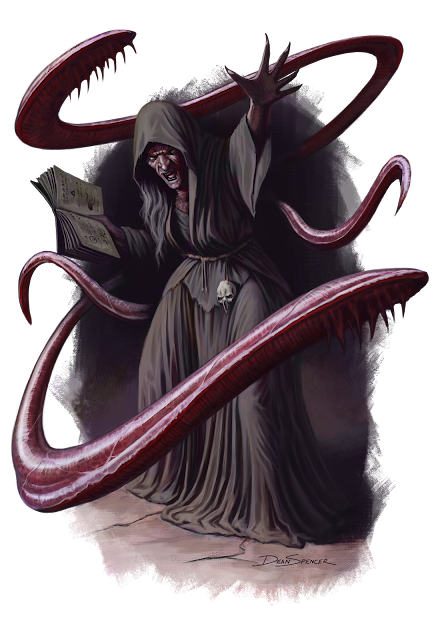
A seeker of the great void, tentacles coming out of blackness behind him
Some artwork © 2015 Dean Spencer,
used with permission. All rights reserved.


Seekers of the Great Void

The Seekers of the Great Void are one of the most “out there” cults I’ve done. They push mechanics quite a bit, with new Gifts, use of multiple types of magic, as well as a Creature Ability as a Gift and are unabashedly inspired by the AD&D 5th edition Warlock. You can see that in the spells mainly, as well as the progression of those. The folk magic spells like Disruption, Darkness, and Protection map directly to equivalents in the warlock. The theism spells Mindlink and Illusion also translate somewhat closely to their analogs.

However, I wanted some things that were a bit more Mythras flavored. Something a little darker, something that leveraged the tools that Mythras provides. Some of the other spells (Corruption, Madness, Obliterate) felt appropriate and give it a real edge that make it distinct. In addition, I’ve added an Oath and a Taboo, leveraging the restrictions for a cult. In so many ways, restrictions like this provide flavor and defined the “space” that a cult operates in. A GM could easily change the Taboo to a Geas if it felt more appropriate to have the planar being granting power be more involved, but the Taboo makes it more of a social faux pas, and potentially dangerous to the Seeker.

 You can also see this pull between the desire for the familiar and pushing to uniqueness in the Gifts. Several of the Gifts translate directly to similar abilities on a 5e warlock, but with a Mythras nuance by affecting folk magic spells they already gain access to. Lastly the Chaotic Blessing is designed to be a gamble. Not all of those are going to be easy for the warlock to deal with. They make the warlock clearly in consort with mind breaking beings. They do then to have a bit more power behind them. At the high end, one is required – those beings want their advertisement as well.

Setting Suggestions

The Seekers (perhaps under another name) can fit into many settings where you desire Lovecraftian spice added to the campaign. A blighted hermit in Mythic Britain, shunned by Druid and Christian alike, would make a wonderful Seeker. Perhaps Luther Arkwright’s WOTAN has determined that dabbling in the darker arts and making unsavory pacts is how to beat the Disruptors, and a few agents volunteer to be the instruments of their sanity-shattering will. Men of Thennla’s Jekkarene Theocracy denied entry into the Moon Goddess’s cult and access to theism or sorcery might seek an untraditional route. It is designed to be a pretty ominous cult, and would be incongruous with some campaign flavors.

Mythos and History

Humans have long sought forbidden lore, pushing them to the very edges of sanity. The mind-bending, multidimensional, dark gods who dwell in the deep outer realms whispered promises of power and wealth across time and space, heard the call, and provide power for their own unfathomable reasons.

Nature

At its very heart, this cult works to bring its dark master from the beyond into this dimension. Occasionally this works, but most of the Great Old Ones are too alien to even understand their demanding followers. Because of this, they work to gain temporal influence and maintain their position, recruiting those in positions of power or with control over particularly valuable resources. This brings them into conflict with local authorities or entrenches them more fully.

Organization

Small cells working towards their dark master’s ends, hidden from the rest of the population, make up the organization. Associates come from family members and others who have close relations, and take a trial of loyalty, ensuring those entrusted with any secrets are well vetted. Sometimes, new members are recruited from the children of those in power, or from those in power themselves.

Membership

Standard. Most who follow the Great Old Ones are insane or desperate, but occasionally heroic characters manage to balance their own natures with the mind-bending desires of their otherworldly patron. These too serve their master, in their own inscrutable way.

Restrictions

Everyone in this cult takes an Oath towards the cult, starting at 30%+POW+INT, as well as a Taboo towards revealing its secrets. Violation is punishable by death.

Skills

Deception, Devotion, Exhortation, Insight, Lore (Great Old Ones)

Magic

Initiates of the Great Old Ones learn a modicum of Folk Magic, including Babble, Befuddle, Curse, Darkness, Disruption, Frostbite, Phantasm, Protection, Shove, and Witchsight. They also learn the Theism spells Illusion and Mindlink. Acolytes learn Madness and Mindblast. Priests learn Corruption (transforming the target into a tentacled monstrosity) and Obliterate.

Gifts

At each rank above Initiate, Seekers gain a gift from the list below.

  • Unfettered Disruption - when the seeker cast Disruption, they may choose up to one twentieth of their Folk Magic in targets to suffer the effects. This does not allow a single target to be chosen more than once.
  • Puissant Disruption - step up the damage of the seeker’s Disruption spell to 1d4.
  • Writhing Protection - your Protection spell does not end when triggered, instead lasting for the entire scene.
  • Familiar - as Animal Familiar Mythras, p202. This is an extra dimensional being in the form of the natural animal with unearthly mutations, though it has an INT score equal to the animal’s INS score and can follow more complex commands. It can speak telepathically to the Seeker within 3 meters.
  • Chaotic Blessing – The seeker gains a chaotic feature, rolled randomly from the Seeker Chaos Feature table below (reference the Chaos Features table, Mythras p275, for effects)

Seeker Chaos Feature Table

Roll

Feature

Roll

Feature

Roll

Feature

Roll

Feature

01-05

Acidic

26-30

Climbing

51-55

Mutated

76-80

Poisonous

06-10

Alluring

31-35

Disturbing

56-60

Nerveless

81-85

Projector

11-15

Boneless

36-40

Entangle

61-65

Obfuscating

86-90

Scintillating

16-20

Brainless

41-45

Levitating

66-70

Oversized

91-95

Shadowy

21-25

Chameleon

46-50

Mimic

71-75

Perceptive

96-100

Slimy

High priests automatically gain a roll on the Chaotic Blessing table as an extra gift.


Monday, June 5, 2023

Four-Fold Battle Wizard

A wizard with glowing balls of power in each hand
Art by www.athelu.com

This cult started as a challenge, though those who laid it did not know at the time. Many on the Mythras Discord had asked about the power of the Wrack spell. It had become a sort of joke, and those who were more senior in Mythras had recommended it only be included at higher ranks, or perhaps even completely avoided.

I decided to make a sorcery cult that relied almost exclusively on it.

Part of this was because I didn’t like the answer being given. I felt it missed the point of Mythras magic systems – you are supposed to manipulate and alter them. After all, there are sections on how to use ritual magic and how to tune magic point recovery to match a particular tone. It felt rather glib to ignore this entirely.

The Battle Wizard makes heavy use of modifications in Sorcery. It gains limited access to Shaping Components and must increase rank to gain access to more. There is an in-game reason listed, but from a gameplay perspective, it is designed to limit the power of Wrack by itself.

Each form of Wrack has some nuance that may make it more or less useful in a particular situation. None of them completely bypass armor as well as force an evade check. All but one have a secondary effect that can be brought to bear. This gives each version its own reason for being, and incentive to gain more. Choosing which to gain as an Apprentice will shape many choices in the future.

Additional sorcery spells are picked to provide them with some options, but some are protected from being used in too many shenanigans by restricting them to this school. This gives the school an exclusive feel and makes it safer for most any campaign. These were picked to give it the flavor of being a military wizard. While replacement is certainly possible, careful consideration should be given to which will give the most flavorful effect, and what restrictions should be placed on them.

The first Gift they receive is designed to get by a question that had come up frequently – do you really mean it can be cast repeatedly for the Duration? Well, yes, it does mean that. Without Range or Target, though, your Battle Wizard is going to have to get up in the thick of it. Once they become Adepts, they can dish out a lot of damage over a long range, but also have reached a level where power should be seen.

Once they get to the Mage rank, they gain access to two Shaping Components – Targets and Ablation. This gives them a remarkable amount of flexibility with their spells, but also forces choices about where to put those shaping points. GMs who use the Battle Wizard should feel quite liberal in their use of protective magics, as would befit a world that has powerful Wrack-slingers. This will force the Battle Wizard to make a choice to erode the defense, increase the magnitude to overcome defenses, increase the number of targets, or increase the range.

Setting Suggestions

The Battle Wizard really shines in a fantasy setting, where a king rides onto the field at the head of a charge supported by a platoon of blasting bearded mages. It would mesh very well in a game that includes the Aegis Arcanum.

It probably works best in Medium to High Magic games, where Magic Points flow freely. In a Low Magic game, will take on a very different role, and will likely have to augment their magic skills with other skills greatly.

Four-Fold Battle Wizard

Mythos and History

Four-Fold Battle Wizards is frequently criticized by other sorcerers for a lack of diversity in spells. Largely focused on variations of the Wrack spell, others think of them as a “one trick pony”. The battle wizards, on the other hand, might argue they can do both kinds of magic, fire and lightning. 

However, they are viewed, no one can deny they are effective in battle. With the ability to create walls of flame or acid or wrap their fellow soldiers in protective armor, they are appreciated. Arch Mages (or Magus General) are particularly valuable, being able to coordinate between unit commanders quickly via telepathic communication.

Nature

The school itself focuses on mastery of destructive forces and manipulating them. Many accidents over the years have led them to develop new techniques and spell-weavings to minimize any collateral damage from their magic.

Organization

There are no official lay members of this cult, though more senior members do keep an eye out for likely apprentices to add into their ranks. Most Four-Fold Battle Wizards (often shortened to just Battle Wizard) learn their craft in a military magic school, with strict discipline and learning to control the magic. As Battle Wizards gain in rank, they also gain in responsibility, and learn to coordinate between mundane and magical forces.

Membership

Standard. While not required, it is common for those of this school to be from the upper echelons of society, with parents who paid their way into a “less dangerous” and more prestigious role in the military.

Restrictions

Battle Wizards start with a very limited set of Shaping components to work with, as to somewhat mitigate the damage a young sorcerer can cause. Eventually, they gain access to all of these and more. Apprentices in this school only have access to Combine, Duration, and Magnitude when casting spells with Invocation (Four-Fold Battle Wizard). Adepts gain access to the Range component, and Mages learn the Targets component.

Skills

Insight, Invocation (Four-Fold Battle Wizard), Lore (Strategy and Tactics), Shaping, Willpower

Magic

Apprentices are taught the Folk Magic spells Darkness, Disruption, Extinguish, Frostbite, Ignite, Light, Shock, Tire as well as the one of the Wrack variants of their choice listed below. Adepts learn another variant of Wrack as well as Protective Ward, and regularly use it to cordon off an area. Mages soon learn the value of defense and learn Damage Resistance and another variant of Wrack. Damage Resistance can only be cast Combined with Protective Ward when using Invocation (Four-Fold Battle Wizard) and cannot be Combined with spells from other schools. Finally, archmagi can be recognized by their mastery of all four variants of Wrack as well as their knowledge of the Telepathy spell.

Wrack - The Battle Wizards eventually learn 4 different types of Wrack

  • Fire - Bolts of fire that bypass half armor, can be evaded or parried as a missile weapon, treated as a Small Force weapon at range. Can light objects on fire as per fire of half spell intensity
  • Acid - a stream of acid that directly attacks armor, treating the armor points as the armor hit points. Armor must be destroyed completely before hit point damage to the target can be done. Can be evaded or parried as a missile weapon, treated as a Small Force weapon at range
  • Cold - a blast of frigid air that bypasses armor completely and is resisted with Endurance.
  • Lightning - Strokes of lightning that bypass half armor, can be evaded or parried as a missile weapon, treated as a Small Force weapon at range. Can gain the Stun Location special effect.

Gifts

All versions of the Battle Wizard Wrack spells have additional flexibility: they may change the targets they have with the spell as a Proactive action. This does not allow them to exceed the number of targets dictated by the Targets Shaping component, but it does give them flexibility in their use. This cannot be used when Combining with spells from outside this school.

Mages become Empowered, gaining access to the Ablation shaping component for spells in this school. When using this component, it cannot be combined with spells that are not in this school

Archmagi achieve total Mastery of their spells, gaining access to the Precision shaping component for spells in this school. When using this component, it cannot be combined with spells that are not in this school.


Tuesday, May 30, 2023

Cults, Cabals and Convocations

I love that the Mythras system gives you a richness, or at least the path to a richness in gameplay that's always closely tied to the world around you.  One of the major gripes I have about other very popular systems is how disconnected the PCs become.  Disconnected from the world, from their own progression and the other players.  


As a GM who loves worldbuilding with my players I wanted a way for them to sink their teeth into that world.  Tanalaeth is a longstanding worldbuilding project I've been adding to, carving away and shaping for over 20 years now.  It has a few clear analogues with real-world cultures from around the end of the Bronze Age onwards.  


This series of Cults, Cabals and Convocations I'll be sharing all come from the world we've built.  There's likely nothing groundbreaking about that world but my hope is that it feels familiar and has some elements you might take inspiration from or include at your table perhaps.  It's fantasy, grounded without being low or high I believe, but tries to keep that connection and respect for verisimilitude.  Cultures need strong groups to bind them and protect them and so we'll explore a few of the options we've developed for our game. 

Raleel has kindly given me some space to explore this with you all so if you'll suffer my experiments and humour me some I hope you find them interesting and maybe even of some use to our table.  


Monday, May 29, 2023

Aegis Arcanum


A white robed wizard, holding a book
Art by www.athelu.com

Aegis Arcanum

I have thought that wizards specializing in protection magic needed a little bit of “brand management”. It has come across as decidedly prosaic and pedestrian, even though some portrayals (notably in manga and anime) have sorcerers who could rightly be called specialist in protection magic being central to stories and sexy in their own right.

The Aegis Arcanum was designed as part of a suite of sorcerers who are all focused on a single “school” of magic. It works well by itself but building a wizard that has one shaping skill and multiple invocations, including the Aegis Arcanum, makes for an incredibly versatile and deadly mage.

The lower ranks of the hierarchy are built around spells that are broadly useful for a small group of stalwart adventurers who might run into deadly obstacles. Avert, Bypass, and Pathway all overcome barriers, as can Dispel Magic when leveraged against magical ones. Alarm, Deflect, Ironhand, Lock, and Protection all create perimeter or barrier. The trio of resistance spells really are the hallmark of the junior mage and will make him valuable in any party, but Shieldmage gives an extra edge that is wholly unique to the school.

More advanced mages start moving into more and more esoteric protections, able to resist and deny tribulations that are rare and deadly. Being able to Abjure (Petrification) and Abjure (Toxins) on your entire band makes a fight with a medusa a much more trivial task, and Castback makes targeting the mage much trickier. Once they have matured, they are offered Runewarding (Enchant) to combine their magic with their material constructions, or even on themselves.

I reserved Protective Ward for the top rank on purpose. It is quite strong with someone who can have so many resistances going. Areas of Abjured heat or breathing are all quite useful, but areas of Abjured gravity or time have godlike potency. It also gives those that choose to focus and become an Archmagi a real reason to push for it, beyond being able to banish demons and imprison foes they come across.

The Archmagi Gift of Invulnerability is intended to be strong and restrictive. The example of the weapon is a good start, but you could make them immune to poison but unable to gain nutritional value from anything that was not poisonous. Finding the right balance is important – it should have an impact occasionally, just as the Invulnerability should.

Setting Suggestions

As is, the Aegis Arcanum is well suited to a fantasy setting that has an organized military. Engineering skills allude to this, placing them in a role where they would build and potentially tear down defenses. This could show up in one of the myriad worlds of Luther Arkwright, perhaps even more modern or post-modern ones. A simple change of that skill could move it into other setting spaces – Medicine to make a healer or Courtesy for a court security wizard.

The Aegis Arcanum should work well at most magic levels. At the highest levels of magic and of the school, it can be quite potent, being able to Abjure whole areas, but likely have a strong role in protecting a society.

Mythos and History

The very earliest of mages were seeking to protect their tribes from the darkness, whether that manifested as predators, spirits, or beings of chaos who lashed them with eldritch energies. The earliest of these efforts focused on building walls and fortifications to hold them back, but this expanded once communities learned of sorcery. Experimenting with words of power, sigils inscribed in the sand around their settlements, and rituals that shackle those that would harm, it was clear to the community the value they would provide. Thus, the art was fostered.

Nature

The abjuration school learns how to protect, and eventually, imprison. Mirroring their magical learning, most gain knowledge of construction of defenses and siege engines, making them very valuable to communities in hostile lands. Royalty will often pay handsomely to have them in their armies, and Arch Mages command staggering sums. Wherever they go, “white wizards” are welcomed.

Organization

Not as many sorcerers dedicate themselves fully to this school as some others, often stopping progression as Apprentices, but those who do are virtually unassailable by weapon or magic. Thus, at the lower levels, the school structure is very loose, with informal relationships forming between Apprentices and Adepts or Mages. Apprentices frequently maintain themselves as construction foremen and expert craftsmen while continuing their studies.

At the higher levels of the order, Adepts, Mages, and Archmagi often organize and distribute themselves, defending larger and larger areas. With enough organization, they can share their resources and learning, forming vast libraries filled with treatises on defenses both mundane and magical.

While not considered formally lay members, many who become apprentices come from construction and engineering guilds guilds

Membership

Standard, as per Mythras p197-199. Apprentices must know at least five of the skills taught by the school at 50% or more, Adepts must have at least four at 70%, Mages at least three at 90% and Arch mages at least two at 110%. Because of the lack of availability of the Engineering skill to the general population, it is very common to be from an engineering guild. 

Restrictions

All Adepts and higher have a Taboo against killing innocents. 

To advance to the Mage rank, the Adept must have been witnessed casting a Combined Turnblade, Turnhex, and Turnshade spell by a Mage or Arch Mage.

Archmagi accept a Geas related to their Invulnerability gift. Breaking this Geas removes their Invulnerability until they can undergo a month-long cleansing ritual. At this point, they may accept a new geas and gain a new Invulnerability at the cost of 10 xp.

Skills

Engineering, Insight, Invocation (Aegis Arcanum), Shaping, Willpower

Magic

Apprentices are taught the Folk Magic spells Alarm, Avert, Bypass, Deflect, Ironhand, Lock, Pathway, and Protection as well as the Sorcery spell Dispel Magic (Neutralize Magic). 

Adepts are additionally taught Turnblade (Damage Resistance), Turnhex (Spell Resistance), and Turnshade (Spirit Resistance). 

Mages can learn Recant (Abjure), Reflect the Arcane (Castback), and Runewarding (Enchant) spells. Each version of Recant (Abjure) must be learned separately at a cost of 5xp per spell. The Path of Defense has a wide number of these available. 

Archmagi learn Bulwark (Protective Ward), Expel Demon (Banish), and Oubliette (Imprison) which manifests as a ghostly oubliette, though the ceiling trap door does not allow for escape.

Gifts

Adepts and higher are entitled to wear the white robes of an Abjurer, showing to all that they are benevolent. This, in turn, means that they can gain food and shelter for themselves almost anywhere there is a settlement. These provisions may be meager, but they will suffice for most.

Adepts also gain the ability Shieldmage, which allows them to use the Protection spell with a Range of their POW in meters, and as a Reactive Action.

Magi can cast the Ironhand spell at will with no magic point cost.

Archmagi gain the Invulnerability gift (Mythras, p202). The specific invulnerability depends on the archmage (work out which one with your GM depending on the campaign) and is related to their geas. For example, an archmage with Invulnerability to weapons may vow to not use weapons in battle.


Sunday, May 28, 2023

Introduction Part Deux

New Beginnings 

After a little more than a year and a few posts, I've decided to take this a little further. I'm inviting some community folks who wanted to put out their own fan materials. Hopefully we'll see a little more content on here and drive some new discussions.

Goals

  • I still have a goal to answer questions that come up often. Some of these take a bit of describe, so this provides a good medium for that
  • A place to publish content that people don't really care that much about getting paid for. Many of us have homebrew things and this provides a handy way to share.
  • Provide discussion points for the Discord server.

Podcast

Bil and I did a bit of a podcast. No guarantees when we will do an episode, but we have done quite a number. It may be useful to you. Click the link to see our episodes though you can find it where you get your podcasts.

Tuesday, November 1, 2022

Iconic D&D party, but as Mythras, Part 2

    In my last post, I started the process of making an "iconic" party for Mythras, similar to the ones available in D&D and Pathfinder. In this post, I will finish the process for each of the characters, and give you some rationale on why I went the way I did. I've broken down the points at each stage to make it clear which ones I felt were important.

    A note to Mythras players - D&D characters tend to be much more focused than Mythras characters, and I've opted towards this mindset for the sake of communicating familiarity. I've also opted to deviate from the pregenerated Kara, Anathaym, and Mju as presented in Sariniya's Curse. Your Mythras May Vary and all :)

Kara

In many ways, Kara is the easiest of the characters. She has a cult already in the book (Myceras, p210) and doesn't need a lot of equipment. In this, we lean into the story that Myceras is the god of the herd.

Characteristics

STR 8 CON 10 SIZ 12 DEX 13 INT 13 POW 15 CHA 14

Culture - Conceal 5, Deceit 10, Drive 5, Influence 15, Insight 15, Locale 5, Willpower 10, Courtesy 10, Lore (Herding) 15, Musicianship 10.

Career - Dance 10, Deceit 10, Influence 10, Insight 10, Locale 5, Willpower 10, Devotion (Myceras) 15, Exhort 15, Folk Magic 15

Bonus - Devotion (Myceras) 15, Exhort 15, Folk Magic 15, Endurance 15, Evade 15, Willpower 10, First Aid 15, Perception 15, Sing 10, Lore (Herding) 15, Influence 10

Cult Assumptions

    I defined the advancement requirements for the non-military portion of the order a bit different. This is implied in the text for the cult, but I formalized it into requiring initiates to have 50% in devotion, exhort, Lore (Herding), Insight, Influence. In particular, Lore (Herding) is used to tend to the Sacred Herd of Myceras, and a task that many initiates take on as part of their training. 

    In addition to the folk magic spells Bladesharp, Coordination, and Might which can be taught to lay members, I've given Kara Light (in Myceras' role as a bringer of truth), Vigor (to emulates the endurance of the bull), and Beastcall (Cattle).

    For theism spells, I've chosen the 3 initiate level spells from Myceras - Berserk, Sacred Band, and Shield. Those of you who play a lot of D&D will note a lack of healing spells. Don't discount Sacred Band as an alternative. Mythras also has a slightly different gameplay cycle, and returns to town are fairly expected to recharge your devotional pools. Once Kara becomes an Acolyte and can Consecrate, she will have more freedom to move about.

Equipment

Kara doesn't really use weapons, as Myceras requires initiates to stop martial pursuits. However, she does have a fine suit of AP 3 armor provided to her by the cult. This is a nod to suits of armor generally coming in the starting equipment of new characters in d20 games. In Mythras you would roll on the table, and likely get a partial set. Otherwise, give her standard Mythras equipment.

Anathaym 

A starting member of the Scarlet Spears, Anathaym is pretty simple. The one true complexity here is that she needs some definition in a Brotherhood. We define the first 2 levels here, with an eye towards Anathaym's role in the party and in the world.

Characteristics

STR 15 CON 14 SIZ 12 DEX 13 INT 12 POW 10 CHA 8

Culture - Conceal 10, Deceit 10, Drive 10, Influence 5, Insight 10, Locale 5, Willpower 10. Lore (Geography) 5, Courtesy 10, Streetwise 10. Combat Style (Citizen Legionary - spear, shield, shortsword, sling; Formation Fighting) 15

Career - Athletics 15, Brawn 15, Endurance 15, Evade 10, Unarmed 5; Combat Style (Citizen Legionary) 15, Lore (Military History) 5, Lore (Strategy and Tactics) 15, Survival 5

Bonus - Lore (S&T) 15, Brawn 15, Athletics 15, Evade 15, Endurance 15, Combat Style 15, Lore (Military History) 10, Lore (geography) 5, Willpower 10, Unarmed 10, Insight 10, Folk Magic (bonus skill) 15 (Bladesharp, Coordination)

Cult Assumptions

    There is no definition of the Scarlet Spears. What we will say is that Associates (the equivalent of lay people) are the citizen militia, and are taught the Citizen Legionary combat style. They drill a couple of times a month and work together as a unit and are provided with a shield, spear, and sling. Exceptional Members, or those who dedicate themselves to the defense of the city, are invited become Apprentices.

    Anathaym is one of these Apprentices. As with all of Apprentices of the Scarlet Spears, she receives a full set of AP 4 armor and a shortsword showing her station. She additionally receives training in the Shield Wall trait (Added to her style) as well as the custom trait Shield Rush

Shield Rush - when using your shield to Bash, step up the damage die for the purposes of determining Knockback.

Additional advancement provides additional benefits, of course.

    Anathaym is also a lay person in the cult of Myceras, where her sister is an initiate. She's learned the folk magic spells of Bladesharp, Coordination, and Might

Equipment

As noted above, a good chunk of Anathaym's equipment comes from her membership in the Scarlet Spears. Otherwise, give her standard Mythras equipment.

Mju

Mju requires a bit of work, but he still isn't too bad. In this, we've decided to expand upon the school of Impenetrable Silence, making him a mystic. His Nomadic background is history. I envision his people as wandering tinkerers, not welcome in many places, and having to learn to get by by keeping their heads down. Their wagon-camps are often places well outside of town. For those who show kindness to them, they receive like in return. Those who treat them unkindly are not likely to know what is about to befall them.

Characteristics

STR 14 CON 13 SIZ 8 DEX 15 INT 10 POW 12 CHA 12 Culture - Endurance 10, First Aid 5, Locale 5, Perception 15, Stealth 15, Athletics 10, Drive 5. Navigate 5, Survival 5, Track 10. Combat style (Wagon-rider: Dagger, Staff, Shortbow, Shortsword, Skirmisher) 10 Career - Athletics 5, Endurance 5, Evade 15, Insight 5, Perception 15, Willpower 10; Sleight 15, Meditation 15, Mysticism 15 Bonus - Combat Style (cultural) 15, Conceal 10, Deceit 15, Evade 15, Lockpicking 15, stealth 15, mysticism 15, meditation 15, sleight 15, Willpower 10

Cult Assumptions

The major alteration I made here is that I allowed Sleight to be a career skill for a Mystic. As it is a cultural school, I felt it not overly stretching it to allow him access. Mju gains access to the Student level talents of Augment Perception, Augment Stealth, Invoke Adhesion, and Invoke Dark Sight. His cult has also allowed him to add the trait of Assassination to his Wagon-rider style.

Equipment

Mju needs very little, having been provided a suit of AP2 armor by his cult and a few weapons. Otherwise, as standard Mythras equipment.

Kratos

Kratos requires the most work, because we are essentially inventing everything whole cloth - story, cult, and so on. We've defined a new Cult who has a role to oversee the herd. This is specifically outside of the direct worship of Myceras, but has unique abilities to counter the influence of his serpent demon adversary. I didn't specifically put in a Geas here, but putting in that sort of thing really can add a lot of flavor. D&D's "wizards can't wear armor" would be a fantastic sort of geas, but with Mythras, we can make them quite different. One note in here - I didn't give Kratos as much Invocation as I could have, in part to reflect the story as told before. He's a bit new, but he got to retain his shaping knowledge. You can also see that his history is reflected in his language and lore. This should make him an excellent defender against the dark spawn of Yethis.

Characteristics

STR 10 CON 13 SIZ 12 DEX 12 INT 15 POW 14 CHA 8

  • Culture - Conceal 5, Deceit 15, Drive 5, Influence 5, Insight 5, Locale 5, Willpower 15, Courtesy 10, Language (any) 15, Lore (Yethis-spawn) 15, Combat style (cultural) 5

  • Career - Deceit 10, Influence 10, Insight 10, Perception 10, Willpower 10, Folk Magic 15, Invocation (Shepherd of Myceras) 15, Shaping 15

  • Bonus - Endurance 10, Evade 10, Influence 10, Insight 10, Perception 10, Stealth 15, Willpower 10, Courtesy 15, Invocation 5, Shaping 15, Folk Magic 15, Language (Servants of Yethis) 15, Lore (Yethis-Spawn) 10

Cult Assumptions

    As the Shepherds are a little different from a Medical order, we'll alter the skill list a bit. I give it 3 professional skills (2 of which are casting) and 2 standard skills - Lore (Yethis-spawn), willpower, invocation, shaping, perception.

    And while Myceras removed his knowledge of Yethis's dark sorcery, he still retains his knowledge of darker folk magics. Not as corrupting by any means, and should allow him to take a more active, aggressive role in stamping out evils. He gains Witchsight, Knock, Disruption, Darkness, Phantasm, and Repair.

    For sorcery, the runes highlighted on the floor of the temple teach him the spells Regenerate, Repulse (Serpents), and Palsy. Of note, I (as GM) decide that palsy also removes pain from the affected limb, which makes it useful in easing the suffering of those with traumatic injuries.

Equipment

Kratos gets standard equipment for a Freeman. While he could wear armor (unlike a D&D wizard), he chooses to leave his chest and back bare, displaying the mark of his station.

Iconic D&D party, but as Mythras, Part 1

When converting characters from another system, it can be useful to see some examples to help to see examples. In this case, we are going to try and make an “iconic” D&D party - a fighter, a rogue, a magic user, and a cleric - but using (almost) only the Mythras core rule book. Of course, they are going to look a little different, but I've made an effort to bring in some touchpoints that should look familiar.

Baseline assumptions

Characteristics

We know that the characteristics can’t be exactly the same, as Mythras has 7 characteristics and D&D has 6 ability scores. So, we are going to take the standard array in 5e (15/14/13/12/10/8), get an average, and make a standard array for human Mythras characters. This gives us an array of 15/14/13/12/12/10/8. This also abides by the Mythras rule of SIZ and INT cannot be less than 8.


Those of you who play Mythras will see that this is a pretty high point value - 84. Since we are emulating D&D, a high fantasy game, this shouldn’t be too far off. It won’t allow for any more than a d2 damage modifier, nor the highest end of hit points. Neither does the standard array in D&D, so this seems like a good starting point.

Characters

Any culture is available, but since we are doing an Iconic set, and trying to match a D&D set of Iconics, we are going to assume the characters are some of the ones presented in the Mythras core rule book and in the adventure Sariniya’s Curse. We have on our roster

  • Anathaym, our trusty fighter. A Civilized Warrior if ever there was one. For her, we are going to have to invent a bit of a brotherhood, and make her an lay person in the cult of Myceras for a little folk magic.

  • Kara, Civilized priest (initiate level) of Myceras. In later adventures she’s presented as a full priestess, but we will assume she is still new for this. We'll end up using most of the Cult of Myceras in the cult section for her, with some small tweaks to get some of the flavor we'd like.

  • Mju, a nomad mystic. He is described as such in Suriniya's Curse (he has meditation and mysticism). We're going to use the School of Impenetrable Silence, a framework for a cult found on p211. He gets a small tweak to his Mysticism school teaching Sleight.


But there is no wizard. So what do we do? Well, everyone loves a redemption arc.


After being captured by Anathaym, Kara, and Mju, Kratos was dragged before the council of Meeros and sentenced to death. Anathaym made an impassioned plea, and with the help of her sister and the example she had set with Mju, clemency was granted - he would be allowed the choice of Rebirth. It was not without risk. The Rebirth ritual asked for had not been performed in a thousand years. The High Priestess of Myceras, Ludovica, warned them, but their minds were set.


Kratos was taken to the temple and stripped naked before the statue of Myceras that had so recently come to life. Initiates danced around home, chanting for him to return to the herd, to give up the serpent that had corrupted him, sponging his haggard form with milk from the Sacred Aurochs the temple kept. Ludovica read aloud, her voice reverberating through the halls, from an ancient scroll so old it could be smelt at 20 paces. A crowd of the faithful gathered, joining the initiates in their chant, braying and grunting and stomping and dropping to all fours in ecstatic fervor for the Bull God.


Ludovica raised her arms wide and everything fell silent. The initiates dropped to the floor, the sweat from their bodies mingling with the milk running from Kratos’ body. She cried, “who will take this calf as their own? Who will nurture it and feed it from their Udder? Who will bear the burden of the stray and teach it our ways?” The crowd grunted and clamored and mingled, waiting to see who would step forth.


“I will!” cried Kara. “I will succor this lost calf and give unto it my Milk! I will teach it the way so that it may love the earth and roam free again!” With this, she took a curious waterskin, larger than a human’s head with multiple spouts coming from it, and brought it forth to the naked Kratos.


“You must drink, my calf, or you will die. You must suckle to live!”


Looking at her warily and wearily, Kratos reached for the skin and drank. When it touched his lips it burned, but when he swallowed, he fell in pain, screaming. High Priestess Ludovica began chanting furiously and the initiates resumed dancing frenetically. Kara stepped back and joined the chant, over and over proclaiming “This is my calf! This is my calf! It has suckled from my Udder! You cannot have him!” A battle against the serpent demon-god that had poisoned him.


The milk on Kratos’s writhing body began to shine white, but also something inside him, tracing his veins, began to glow a sickly green and throb. The milk bubbled as if boiling and expanded around him, eventually encompassing him completely so none could see all of his form, only a hand or a foot pressing against a thick membrane, a milky caul.


Kara finally screamed, a scream like a woman in childbirth, and dropped to the floor in exhaustion and pain. In unison, the initiates dropped as well and raised their hands, all kneeling around the caul in a near perfect circle. Into the imperfection stepped Ludovica, her hands grasping at the caul. As she tore it, befouled milk gushed forth from it, spilling across the tiles. And where the milk touched, a rune appeared, each one being traced by a rivulet.


A gasp rushed across the crowd and a single word could be heard in the murmur of amazement. “Shepard!” “A shepard!”. On Kratos’ form, blazoned across his back, the head and horns of a bull extend from shoulder to shoulder. 


An old woman, hunched over and using a cane, comes forward and grasps at Kratos, cradling him. He looks up at her, bewilderment in his eyes, “Mother?”


“All is forgiven, my son,” she responds. “The bull on your shoulders will help you carry the heavy burden you now must bear.”


Here we have given Kratos a new way, and introduced a Myceras-blessed form of sorcery. Over the course of the story, Kratos gains redemption. His knowledge of the dark sorceries he learned are purged from him, but leave him with white sorceries. His bull-scar is evidence of something more - perhaps a geas, perhaps something else, that helps to keep him on the straight and narrow. With this, we now have Kratos as a Civilized Sorcerer. We will give him a modified version of the Medical Order framework, presented on p212. Notably, he will have some different skills, as befitting his role as a Watcher of the Herd, and give him Repulse (Serpents) as an alternative to Repulse (Vermin). It keeps with his theme and ties it to the mythology of Myceras a bit.


In the next post, I'll show the build out of these characters.


The Lodge of the Delver's Lamp

  Design note: The intent of this brotherhood is to form a basis for an “adventurer”. What does this mean? Someone who has skills and perhap...